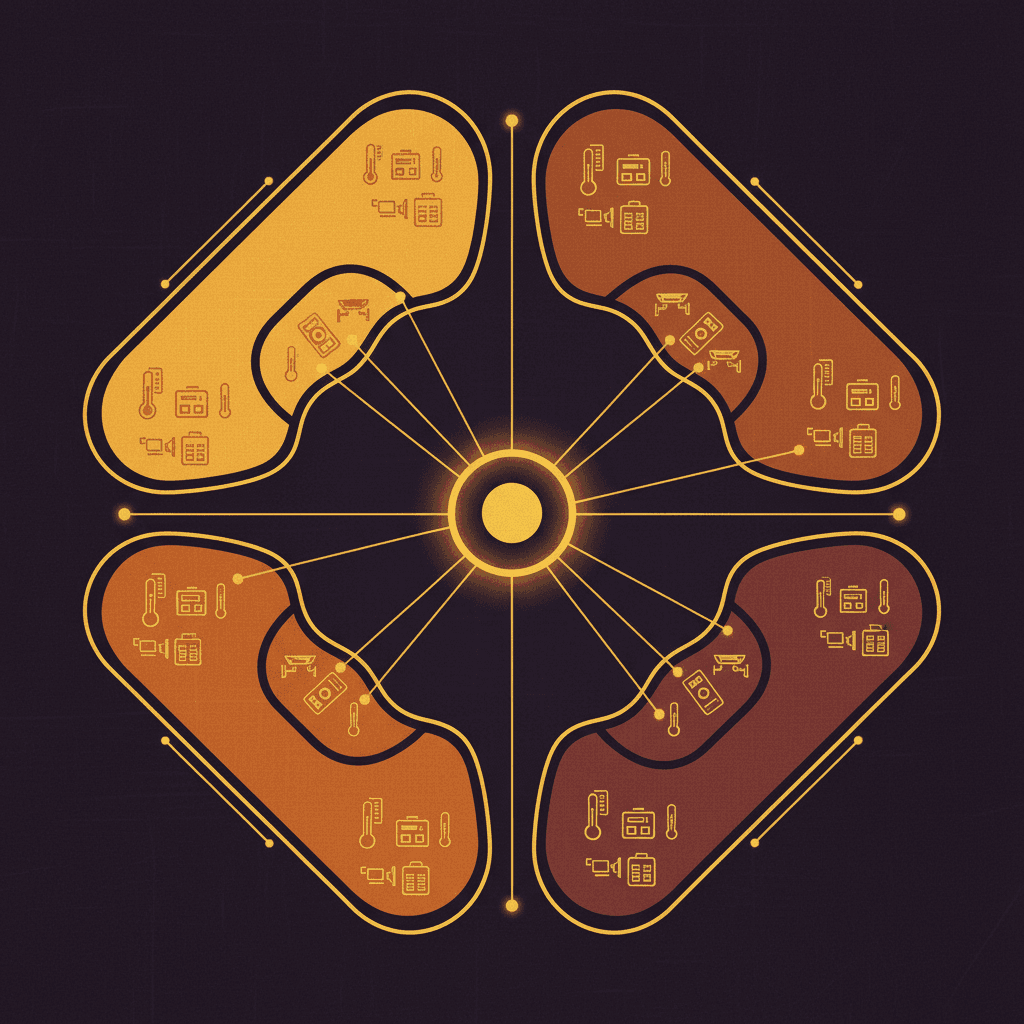
Unified supervision of physical security, environmental conditions, and access control in facilities with critical zones
How an industrial operation with high-criticality areas went from fragmented security and environmental monitoring systems to centralized management with automatic alerting and complete traceability of access, fire, and environmental events.
An industrial operation with high-criticality areas — server rack, production zone, laboratory, sample room, and warehouse — operated with completely independent video surveillance, access control, fire detection, and environmental monitoring systems. Reveal unified the supervision of all these systems into a single platform, enabled automatic alerts for security events and environmental deviations, and integrated digital visitor management with complete traceability.
An industrial facility dedicated to the production of raw materials for industrial products and finishes operated with multiple independent security and environmental control systems. The operations team had no consolidated view of the infrastructure's status, fragmenting information, delaying detection of critical events, and creating dependence on manual processes for functions requiring immediate response.
This dynamic created several concrete operational frictions:
Video surveillance, access control, fire detection, and environmental sensors operated in isolation, without a platform to consolidate the information. Each system required its own interface and its own review process.
The facility's 5 critical zones — server rack, production, laboratory, sample room, and warehouse — lacked continuous and centralized temperature and humidity supervision, variables essential for the protection of equipment, raw materials, and finished products.
Visitor access control relied on manual processes without digital integration, making it difficult to trace entries and exits and creating risk of unregistered access.
Security events — forced access, fire alarm activations, recording equipment failures — did not generate automatic notifications to the operations team, meaning they were only discovered during a manual review or when they had already generated impact.
a progressive temperature or humidity deviation in the server rack, laboratory, or sample room can indicate HVAC failure, an open door, or thermal overload, before damage to equipment or materials occurs.
a video channel disconnection or storage failure in an XVR creates a security coverage blind spot that is only detected if someone manually reviews the system.
a door that opens without authorization or remains open beyond the permitted time indicates a possible unauthorized access or a security condition requiring immediate verification.
any fire system activation — whether by automatic smoke detection or manual activation — requires immediate and coordinated response, which is only possible if the alert reaches the right team at the right time.
a fault condition in the fire panel — disconnected sensor, open circuit, low battery — reduces detection capability without anyone knowing, until a real event occurs.
a decrease in voltage reported by environmental sensors can indicate battery deterioration or power supply issues, anticipating monitoring loss in a critical zone.
Reveal centralizes information from all the facility's security and environmental monitoring systems, supervises critical variables continuously, detects relevant events, and records historical traceability to identify conditions requiring intervention.
In this case, the platform:
Supervises video recorder status — active channels, available storage, and connectivity — detecting failures that can compromise security coverage.
Monitors access control system events: authorized openings, forced doors, and prolonged open doors, recording each event with complete traceability.
Integrates digital visitor management, consolidating entry and exit records into the same operational supervision platform.
Receives fire system status — manual activations, smoke detection, and fault conditions — generating immediate alerts to the operations team.
Records temperature, humidity, and voltage every 30 minutes in the facility's 5 critical zones, identifying deviations that could affect equipment, raw materials, or products.
Generates automatic alerts when it detects any event requiring attention — unauthorized access, out-of-range environmental condition, fire failure, or video loss — channeling the team's response toward exceptions.
- ▸Reveal's value is not in consolidating data from multiple systems into a single dashboard. It is in enabling concrete operational decisions that previously required manual review of each system separately. With this implementation, the team can:
- ▸Respond immediately to a forced access or prolonged open door, instead of discovering it hours later during a review round.
- ▸Activate the emergency protocol upon smoke detection or manual fire activation, with certainty that the alert reaches the right team at the precise moment.
- ▸Intervene preventively when a critical zone's temperature or humidity shows deviation, before damage occurs to servers, laboratory equipment, or raw materials.
- ▸Escalate to maintenance when the fire system reports a fault condition, ensuring detection capability is always operational.
- ▸Verify visitor identity and traceability digitally, eliminating manual registration and reducing the risk of undocumented access.
- ▸Prioritize the team's attention on systems or zones with active exceptions, instead of distributing effort across routine reviews of all systems separately.
Operational result
all security, access control, and environmental monitoring systems are supervised from a single platform, eliminating the need to review each system separately.
the facility's 5 critical zones have continuous temperature, humidity, and voltage supervision, with historical records for trend analysis.
automatic alerts for forced access, fire activations, or equipment failures enable reaction before the event escalates.
integrating digital visitor management with the supervision platform provides complete entry and exit records without depending on manual processes.
failures in video recorders, fire systems, or environmental sensors are detected automatically, without waiting for someone to discover them during a review.
Business result
immediate detection of unauthorized access, forced doors, and fire activations reduces the exposure window to critical incidents.
continuous environmental monitoring in critical zones reduces the risk of damage to servers, laboratory equipment, raw materials, and finished products from out-of-range temperature or humidity conditions.
complete traceability of access, security events, and environmental conditions provides documented evidence for audits and regulatory requirements.
the team focuses on real exceptions instead of distributing attention across multiple independent systems, improving operational efficiency without increasing headcount.