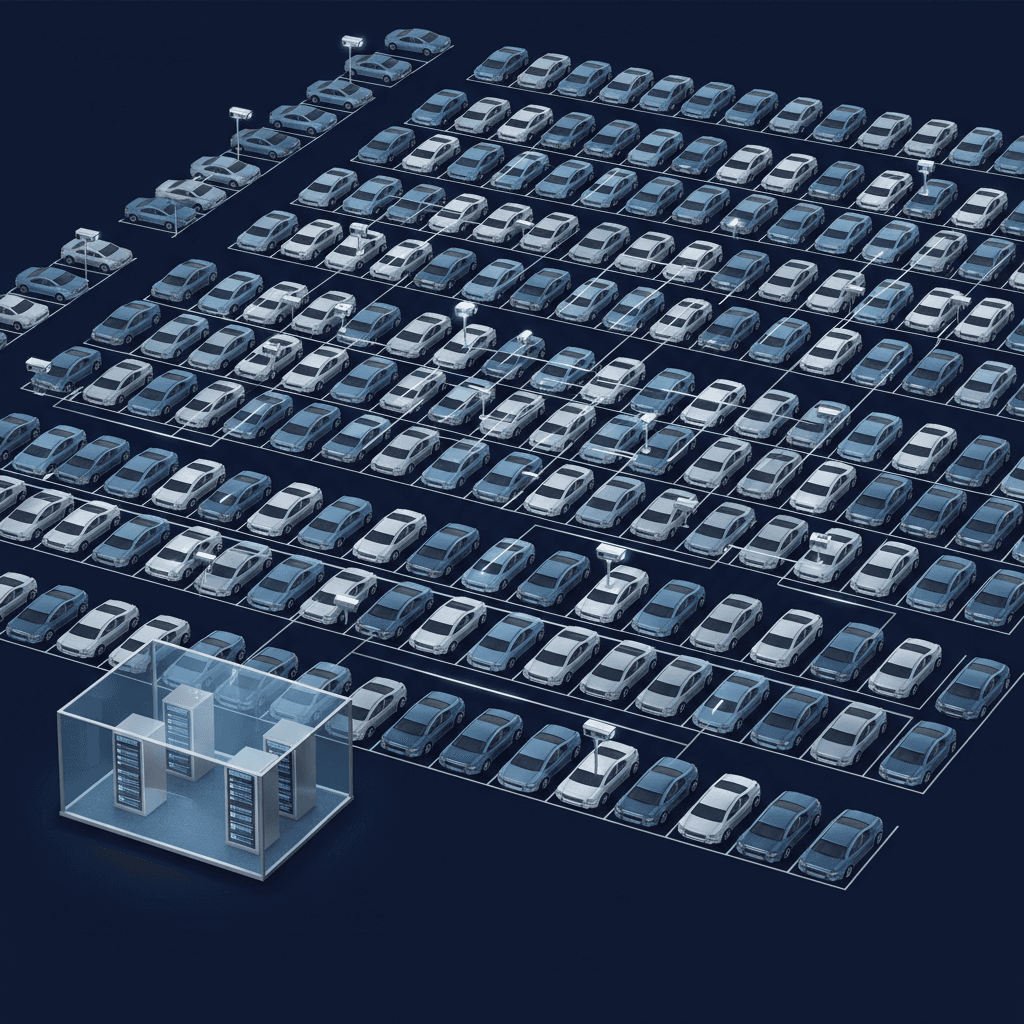
Centralized CCTV infrastructure fault management at scale in automotive sector operations
How a nationwide automotive distribution operation went from manual device-by-device inspections to automated digital supervision of over 1,700 cameras and 180 recorders from a single platform.
A nationwide automotive distribution operation managed over 1,700 cameras and 180 recorders through individual manual inspections, consuming considerable technical team time, delaying fault detection, and leaving video surveillance infrastructure incidents without traceability. Reveal centralized the supervision of the entire CCTV infrastructure into a single platform, automated fault detection for cameras, hard drives, and recorders, and enabled a multi-channel alerting system with complete traceability of each event, eliminating dependence on on-site inspections.
A nationwide automotive distribution operation — responsible for the security of facilities housing vehicles, spare parts, and high-value assets — managed a CCTV infrastructure of over 1,700 cameras and 180 DVR/NVR recorders through entirely manual processes. Each device's status was verified individually, reports were generated manually, faults were only identified after manifesting, and there was no systematic history to analyze fault patterns or make data-driven decisions.
This dynamic created several concrete operational frictions:
The verification of each recorder and camera status was performed individually without automation. With over 180 recorders and 1,700 cameras, the technical team dedicated considerable time to repetitive inspection tasks that did not scale with infrastructure size.
Infrastructure status documentation required manual report generation, involving significant effort, outdated data at delivery time, and limited ability to identify trends or deterioration patterns.
Camera, hard drive, or recorder faults were only identified after manifesting — when the camera was already disconnected, the drive had already failed, or the recorder had stopped functioning. There was no early detection mechanism to allow intervention before coverage loss.
The lack of a systematic incident history prevented analyzing recurring fault patterns, identifying problematic devices, prioritizing replacements, and making maintenance decisions based on historical data rather than point-in-time inspections.
when the number of active cameras on a recorder is lower than configured, it indicates a disconnection, power failure, or network problem that is already reducing video coverage without necessarily having been reported as an incident.
a hard drive reporting write errors, bad sectors, or reduced capacity anticipates an imminent total failure. Without automatic storage health monitoring, recording loss is only discovered when an event needs to be reviewed that was never recorded.
a recorder that loses connectivity intermittently — due to network issues, unstable power, or equipment overload — creates unsupervised time windows that, in a 180-device infrastructure, can go unnoticed for days without automatic monitoring.
outdated firmware versions on recorders can cause incompatibilities, security vulnerabilities, and erratic behavior. In a fleet of 180+ recorders, manual version checking is impractical and accumulated deviations increase operational risk.
when several cameras associated with the same recorder disconnect simultaneously, the probable cause is not the individual camera but the recorder, network switch, or rack power — a condition requiring different and more urgent intervention.
a recorder or camera that presents repeated faults in a short period indicates a structural problem — degraded hardware, defective cabling, or adverse environmental conditions — that point-in-time inspection does not detect but historical traceability analysis reveals.
Reveal centralizes information from the entire video surveillance infrastructure — over 1,700 cameras and 180 DVR/NVR recorders — monitors critical variables of each device continuously, automatically detects relevant events, and records complete historical traceability to identify conditions requiring intervention.
In this case, the platform:
Supervises the status of each of the 180+ DVR/NVR recorders, including system availability, connection status, active versus configured video channels, storage status, and firmware version, detecting deviations that compromise operation.
Monitors the 1,700+ surveillance cameras, automatically identifying disconnections, differences between configured and active cameras, and recording failures that reduce security coverage at the facilities.
Detects hard drive failures — write errors, reduced capacity, total failures — generating automatic alerts before storage loss compromises the recording of security events.
Generates automatic multi-channel alerts — via WhatsApp, email, and Reveal's Alert Dashboard — each time it detects an event requiring attention, with complete traceability of the incident from detection to resolution.
Records a systematic history of all events, faults, and infrastructure incidents, enabling analysis of recurring fault patterns, identification of problematic devices, and data-driven maintenance decisions.
Replaces manual report generation with real-time updated information of the complete infrastructure status, accessible from a single platform without on-site inspections.
- ▸Reveal's value is not in showing the status of 1,700 cameras on a dashboard. It is in enabling infrastructure management decisions that previously required manual device-by-device inspections. With this implementation, the team can:
- ▸Prioritize technical intervention on devices with active exceptions — a disconnected recorder, an offline camera, a failing drive — instead of distributing effort across the sequential review of 180 recorders looking for the problem.
- ▸Escalate to preventive maintenance when a hard drive reports degradation or a recorder shows intermittent disconnections, before the failure materializes and compromises recording coverage in critical facility areas.
- ▸Identify the root cause of coverage loss immediately — distinguishing whether the problem is an individual camera, a complete recorder, a network switch, or a power failure — and direct the right technician to the exact problem point.
- ▸Make equipment replacement or renewal decisions based on the documented fault history of each device, instead of decisions based on equipment age or the technician's subjective perception.
- ▸Coordinate the security and technical team's response to a critical event — such as coverage loss in a sensitive area — with verified, real-time information, without depending on phone calls or on-site inspections to confirm the actual status.
- ▸Demonstrate to internal or external audits the complete traceability of the security infrastructure: what failed, when it was detected, when it was resolved, and what coverage was compromised during the incident.
Operational result
the complete CCTV infrastructure status is visible in real time from a single platform, eliminating the need for device-by-device on-site inspections.
automatic alerts for camera disconnections, disk failures, recording losses, and connectivity problems allow identifying and resolving issues before they compromise security coverage.
real-time updated information on all device statuses replaces manual report generation, freeing the technical team from repetitive tasks.
each event generates an automatic alert via WhatsApp, email, and alert dashboard, with complete incident records from detection to resolution.
the systematic event history enables fault pattern analysis, identification of problematic devices, and data-driven maintenance decisions instead of point-in-time inspections.
Business result
early detection of video surveillance infrastructure faults minimizes time windows without recording coverage at facilities housing vehicles, spare parts, and assets of significant value.
the platform enables managing a large-scale CCTV infrastructure — 1,700+ cameras, 180+ recorders — without proportionally increasing the dedicated technical team size.
by eliminating routine inspections and manual reports, the technical team focuses on resolving real exceptions and higher-value operational activities.
complete traceability of faults, resolution times, and compromised coverage provides documented evidence for internal and external audits and compliance requirements.